
Bhama kalapam: Notes of Affection, Invidiousness & Compunction. Satyabhama's Odyssey From Superciliousness to Absolution
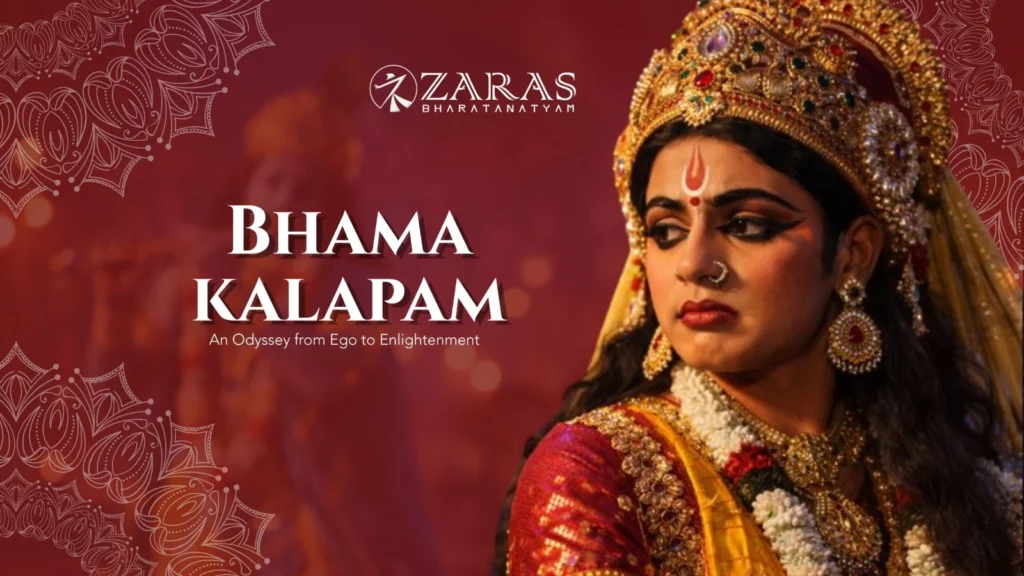
Bhama kalapam is an exalted and acclaimed kuchipudi dance drama skillfully and artistically fabricated and orchestrated by Siddhendra Yogi predominantly with an intention of bequeathing it to his brahmin disciples as a spiritual veneration and imploration to Lord Krishna. It forms an unavoidable and inextricable portrayal and representation of Kuchipudi repository. The intrinsic and ingrained crux of this rendition is the prattling, petulant and nitpicking jealousy of Sathyabhama’s (bhama) belligerent quibble (kalapam) with her husband Lord Krishna. Twinning these integral terms gives birth to the title Bhama kalapam. The plot pivots around Sathyabhama’s vanity, hubris, chunter and jealousy because of her extortionate and extravagant love for her husband Krishna, as expounded in Bhagavata Purana. Siddhendra Yogi is an eurodite vaishnavite poet of 17th century.
According to Siddhendra Yogi , bhamakalapam, is a sringara Kavya that fascinatingly emulsifies and homogenizes the triple verisimilitude viz, natya, sangeetha and kavya. The central, focal and the poignant element in this art form is abhinaya. The role of Sathyabhama is the acid test for an adept kuchipudi dancer who should convincingly and effacaciously bring to fruition the dual rasas shringara and karuna. The performers encumbered to do this crucial, sublime and divine art form are male youths who were handpicked from the Brahmin community. It was done with a view to retaining and perpetuating the purity,rectitude ,sublimity, uprightness and the total integrity of the brahmin community. These youths chosen from the community daintily and felicitously represented impeccably and flawlessly the role of satyabhama with utmost precision. Every role, male or female, was diligently, assiduously and meticulously donned by boys.
Though it is almost humanly impossible to bring the flexibility, docility, and malleability of a female character these chosen boys did a bodacious and fantabulous feat with their swift, rapid and brusque feminine swing and sway which is vital and imperative for the life like role of Satyabhama. When these boys come off age other tweens akin to these teens are roped in and that continued till women took over the scenario. The habiliments and regalia accoutred and bedecked are very bedazzling, ritzy , and exquisitely opulent attuned to Satyabhama’s imperial bequest.
The dance drama commences with the vanity strutting and swaggering of Satyabhama. The whole performance is hinged on to Krishna’s severance from Satyabhama owing to her bashful and bragging behavior in order to teach Satyabhama the quiddity and kernel of salvation. Subsequently Satyabhama comes vis-a-vis with her boastful self realizing her folly and foibles and becomes repugnant and repudiates her old self and contritely repents and seeks forgiveness and redemption from Lord Krishna. She perseveringly and earnestly tries to communicate with Lord Krishna via epistles of heartfelt intimacy with Madhavi, her maid as swan of soul exposition.
This dance drama embodies tri dramatis personae ostentatious & repugnant Satyabhama, an indifferent Lord Krishna and mediator Madhavi. Another substantial trait of this dance drama is that the narration is enrobed in the mantle of Yakshagana, assimilating literary schema like dharuvus, padyams and gadyams. The entire drama endeavor is headgeared by the inexplicable prowess of dancer’s guru from whom they acquired the skills.
